








QSR On-Premises Study 2026.
How do ten leading QSRs make the counter experience count?
This year’s study takes a closer look at how well in-store QSR experiences are holding up at the point of interaction. While operations continue to run smoothly, the quality of revenue-driving moments tell a different story.
WHO’S IN THE MIX? 10 WELL-KNOWN, CONSUMER LOVING QSR BRANDS.
Inside the Report: How Greetings, Suggestive selling, and Daypart performance shape the On-Premises Experience.
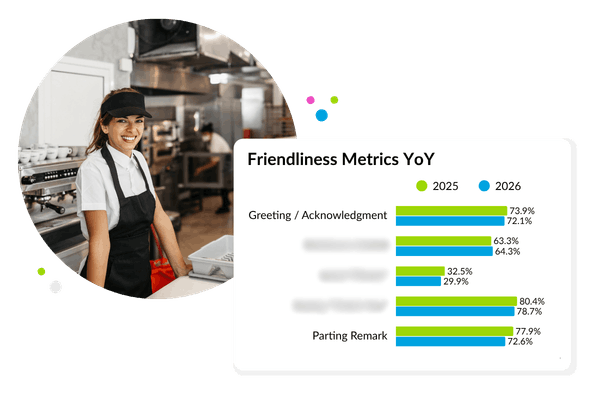
The 2026 QSR On-Premises Study reveals that human connection is falling behind. Friendliness, greetings, and parting remarks all trail significantly. At the same time, suggestive selling stands out as the single biggest missed revenue opportunity.
The human connection gap widens
Greeting and closing remarks are powerful bookends of the counter experience; requiring no extra resources, just intention. Yet, 27.9% of guests weren’t greeted, and 27.4% received no parting remark, showing the habit isn’t consistently embedded.
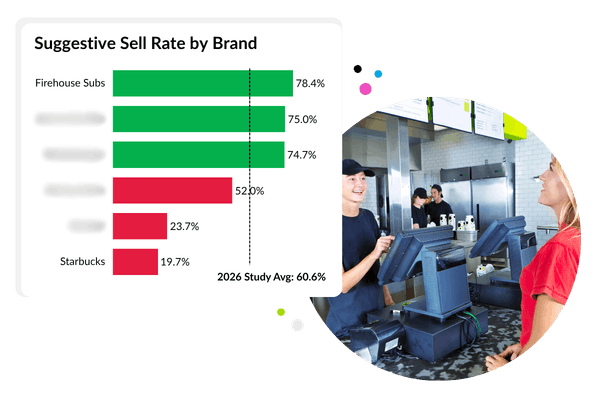
Suggestive selling is the biggest missed revenue lever
Suggestive selling averages just 60.6% across the study, with even the top-performing brand reaching only 78.4%, leaving clear room for improvement. Even small lifts in execution can translate into meaningful revenue at scale. The upside is that suggestive selling is quick to coach, easy to observe, and relatively low-effort to improve.
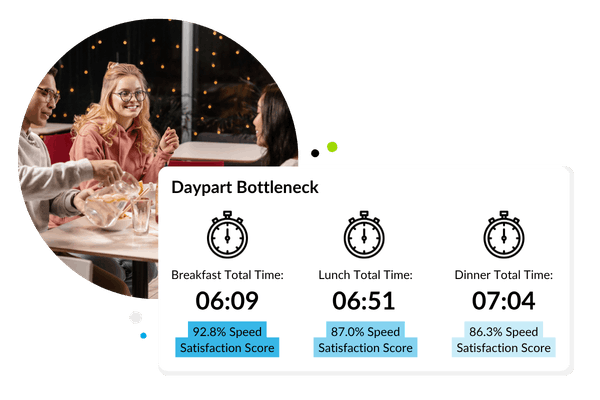
Dinner is the slowest daypart
For the eight brands measured during the lunch and dinner dayparts, dinner emerges as the most demanding for throughput, with the slowest service times in the study. At 04:11 (mm:ss), it trails breakfast by 32 seconds and is slightly slower than lunch.
The key experiences that matter.
-
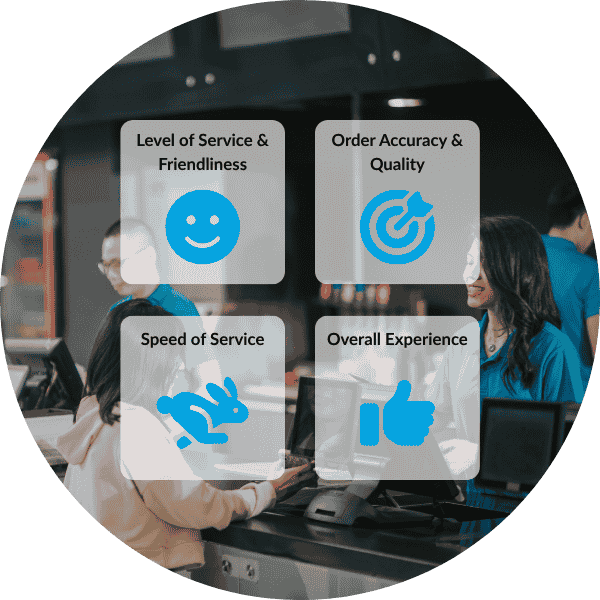
Level of Service & Friendliness
It’s often the small details that make the biggest impact. A smile, a warm hello, or a kind word can turn a simple interaction into a memorable one. We also looked at service touches like suggestive selling, guiding customers where to wait, and helping them identify their order.
-
Order Accuracy & Quality
How would you feel if your order was wrong? Mistakes frustrate customers and cost loyalty. But accuracy isn’t the whole story because taste and temperature of the main item can make or break the experience. That’s why we explored how these factors shape customer satisfaction.
-
Speed of Service
It’s universal - fast, seamless service can turn a one-time visitor into a regular. That’s why we focused on two key metrics that shape the experience: average service time and customer satisfaction with speed of service.
-
Overall Experience
Eventually, we explored the overall experience—evaluating satisfaction by daypart, order experience, and pickup. From the clarity of pickup instructions to whether the ordering experience felt friendly or neutral, every interaction was rated by shoppers to gauge satisfaction.
Research Methodology: How we collected the data
The study evaluated 10 QSR brands, with 75 mystery shops conducted per brand across geographically distributed locations in the US, covering breakfast, lunch and dinner dayparts.
Mystery Shop Allocation
A total of 753 orders were completed across 10 QSR brands.
Timing
Dayparts were split across Breakfast, Lunch and Dinner. Dunkin' and Starbucks were evaluated during Breakfast only during their busiest daypart.
Metrics Measured
The study measures four key metrics: level of service & friendliness, order accuracy & quality, speed of service and overall experience.
Frequently Asked Questions
-
What is the On-Premises QSR Study?
The On-Premises Study is Intouch Insight’s first evaluation of in-person counter guest experiences at quick-service restaurants (QSRs). It analyzes how greetings, communication, accuracy, speed, and engagement shape customer satisfaction.
-
Which restaurant brands were included in the study?
The study evaluated leading QSR and fast-casual restaurant brands across North America to benchmark customer experience performance. The participating brands represent a mix of burger, chicken, coffee, sandwich, and convenience-focused concepts.
-
How was the data collected?
Data came from 750 mystery shops across 10 QSR brands conducted at geographically distributed U.S. locations. Shoppers could visit any day and ordered during breakfast, lunch, or dinner dayparts, while two brands were evaluated during breakfast only based on their busiest operating period.
-
What metrics did the study measure?
The report measured key restaurant performance metrics including speed of service, order accuracy, food quality, friendliness, cleanliness, and satisfaction. It also analyzed how operational execution changes across different dayparts and service channels.
-
What were the headline findings?
The study found that most QSR brands delivered strong operational execution, but the biggest gaps appeared in human connection and service behaviors. Restaurants performed well on speed and accuracy, yet simple interactions like greetings, friendliness, and parting remarks continued to shape how customers judged the overall experience.
-
How important is speed of service in restaurants?
Speed of service remains critical because customers expect convenience without sacrificing quality or accuracy. The report shows that long wait times can negatively impact satisfaction even when other parts of the experience perform well.
-
How can restaurant operators use this report?
Restaurant operators can use this report to uncover where customer experience breaks down across speed, service, accuracy, and frontline execution. The insights help teams identify operational gaps, improve consistency across locations, and better understand which in-store behaviors have the biggest impact on guest satisfaction.
-
How can I get the full report?
You can download the full report by filling out the form on the page; the report will be delivered to your inbox.