A strong customer experience can unravel in the space between headquarters and the frontline. A survey flags a problem, an audit confirms it, a manager receives a spreadsheet, and nobody can see whether the issue was fixed. Multiply that gap across hundreds of locations and even a well-funded Customer Experience (CX) program can lose momentum.
The right CX software features connect those moments. They help multi-location brands collect feedback, understand what is happening, route the right action to the right person, and verify the result. That connected approach matters: Forrester's 2025 Global CX Index found that 21% of brands declined while only 6% improved, with disappointing technology implementations among the continuing pressures on CX quality.
What is CX software?
CX software is a set of tools that helps an organization collect, combine, analyze, and act on customer and operational experience data. A capable platform connects signals such as surveys, mystery shops, reviews, audits, and transaction data, then turns those signals into reports, alerts, cases, and workflows that improve the customer journey.
That scope is broader than a CRM, which primarily manages customer and sales records, and broader than customer support software, which focuses on resolving incoming service requests. A mature CX platform for multi-location brands links what customers say, what employees do, and what each location delivers.
The 7 CX software features to prioritize
For multi-location businesses, the seven most important CX platform features are user and location management, survey and feedback management, case management, workflow automation, integrations and data portability, cross-program analytics and reporting, and reputation management.
As you review each feature, we’ve included a few questions to help you compare your options, along with a practical consideration to keep in mind.
1. User and location management
A multi-location CX program needs to mirror the organization behind it. Corporate leaders may need a national view, regional managers need comparisons within their territory, and store managers need clear actions for their own location. User and location management makes those views possible without exposing irrelevant or sensitive data.
Look for configurable hierarchies, role-based permissions, location groups, user provisioning, and attributes that let you segment sites by region, format, ownership model, volume, or other meaningful factors. The same structure should govern dashboards, alerts, reports, cases, and checklist assignments.
This foundation improves both clarity and accountability. A franchise operator can receive only the cases for their stores. A regional leader can compare resolution times across a territory. Corporate can see brand-wide patterns without manually rebuilding reports for every audience.
What to ask: Can hierarchies be updated in bulk or automatically? Can one user hold different roles across different locations? Does single sign-on simplify access? Can permissions be tested before launch?
One consideration: A rigid hierarchy that requires vendor intervention whenever territories or ownership structures change.
2. Survey and feedback management
Customer feedback gives you the customer's perspective, but the platform must make that feedback easy to collect, interpret, and route. Strong customer feedback surveys support flexible question types, logic, branding, multiple distribution channels, location-level reporting, and timely triggers based on real events.
Text and sentiment analytics help teams organize open-ended comments at scale. The useful output is more than a positive or negative label. Teams should be able to surface recurring themes, compare sentiment by location or journey stage, and connect a comment to the transaction, program, or operational condition that gives it context.
The richest picture comes from combining direct feedback with objective and public signals. Mystery shopping, customer feedback surveys, and reputation management answer different questions; together, they help explain whether a problem comes from standards, execution, perception, or a combination of all three.
What to ask: Can surveys trigger from transaction or event data? How are consent, opt-outs, and response data managed? Can teams compare solicited feedback with reviews, audits, and mystery shops?
One consideration: A survey tool that produces scores but cannot connect feedback to owners, locations, or follow-up action.
3. Case management
Insight has limited value when nobody owns the next step. Case management turns a failed standard, urgent complaint, or recurring pattern into a trackable item with an owner, priority, due date, evidence, and resolution history.
Imagine a grocery chain receives a failed food-safety inspection. The platform should create a case automatically, assign it to the store manager, notify the regional leader if the deadline is missed, capture photos or comments as proof, and show whether the same issue keeps returning. That history gives the business a way to improve the process, not simply close the ticket.
Useful case metrics include time to acknowledge, time to resolution, overdue volume, recurrence, escalation rate, and performance by issue type or location. Those measures help leaders find bottlenecks and see whether corrective action is sticking.
What to ask: Can a case link back to its survey, mystery shop, audit, inspection, or review? Can related cases be grouped? Can teams define service levels and escalation rules? Is every change recorded in an audit trail?
One consideration: A task list that marks work complete but cannot capture evidence, collaboration, recurrence, or resolution performance.
Getting the right information to the right people at the right time is another crucial aspect of case management.
4. Workflow automation that drives action
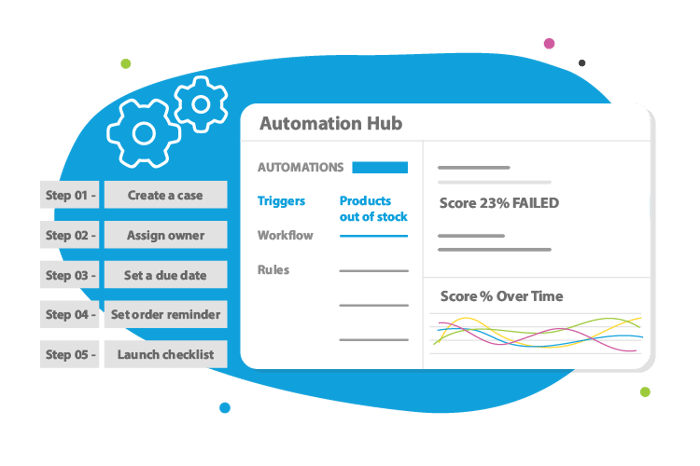
Automation helps a CX program respond at the speed of the experience. Effective automation workflows use clear rules to send alerts, create cases, distribute reports, trigger surveys, assign inspections, recognize strong performance, or escalate unresolved issues.
Consider a restaurant group managing cleanliness across hundreds of locations. A scheduled digital checklist can prompt teams to inspect high-touch areas at the right times. A failed critical item can notify the manager immediately, create a corrective task, require a photo, and escalate when the deadline passes. Well-designed digital SOP checklists make the workflow easy for frontline staff while giving leadership a reliable record.
The same approach supports digital checklists for multi-location compliance, where time-stamped tasks, proof, and immediate notifications help operators reinforce standards across every site.
The best automation is transparent. Teams should understand why a rule fired, who received the action, and what happened next. Rules also need owners and review dates so yesterday's workflow does not quietly become tomorrow's noise.
What to ask: Can business users build and test rules? Can triggers use multiple data points or trends over time? Can the system prevent duplicate alerts? Is there a sandbox or approval process for high-impact changes?
One consideration: 'Set it and forget it' automation with no monitoring, exception handling, or governance.
5. Integrations and data portability
CX data rarely starts in one system. Transactions may live in a point-of-sale platform, customer records in a CRM, staffing data in workforce software, and operational results in audit tools. CX software integrations should move that data reliably while preserving identifiers, timestamps, location mapping, and governance.
Look beyond an integrations logo wall. Confirm the platform supports the methods your team can maintain: prebuilt connectors, secure APIs, webhooks, scheduled imports, exports, and common file formats. Ask who owns setup, monitoring, failure handling, schema changes, and ongoing costs.
Portability matters too. Your organization should be able to export its data in a usable form and understand retention and deletion rules. This becomes especially important as Salesforce's State of the AI Connected Customer reports that 64% of customers believe companies are reckless with customer data.
What to ask: What is available out of the box? Are APIs documented and rate-limited? How are failed transfers surfaced and retried? Can the platform maintain a stable location and customer identity across sources?
One consideration: An 'open platform' claim that depends on manual CSV work or expensive custom services for routine data movement.
6. Cross-program analytics and reporting
A dashboard can describe what happened. Strong cross-program analytics help teams understand where, why, and what to do next by connecting customer feedback with operational measures.
Suppose a QSR launches a limited-time offer. Survey comments show frustration, mystery shops identify inconsistent menu communication, order data shows longer service times, and inspections reveal equipment-readiness gaps in a subset of locations. A connected view helps the team isolate the conditions behind the problem and focus support where it will have the greatest impact.
For multi-location brands, reporting should support brand, region, location, channel, and program views. Teams need filters and benchmarks that make fair comparisons possible, scheduled delivery for recurring decisions, and drill-down access that preserves context. A closed-loop CX measurement strategy then connects each insight to an owner and a measurable response.
This is also where predictive and text analytics can add value, provided the output is explainable and tied to a decision. A model that flags a likely decline should show the drivers and give teams a practical next step.
What to ask: Can we combine internal and external data? Can users compare like-for-like locations? Can a chart open the underlying records? Can reports be scheduled by role and location? How are predictive results validated?
One consideration: Attractive dashboards that cannot connect a finding to source records, operational causes, or action.
7. Reputation management
Reviews, local listings, social posts, and direct messages shape how customers discover and trust a multi-location brand. Integrated reputation management brings those public signals into the CX program so teams can monitor themes, respond consistently, and see which operational issues are affecting perception.
Core capabilities include review monitoring and response, listing accuracy, competitor comparisons, social listening, location-level reporting, response templates, approvals, and escalation paths. Survey integration can also give customers a direct channel to share a concern while there is still time to recover the relationship.
Reputation data becomes more useful when it connects to other programs. A cluster of cleanliness reviews can be compared with inspection results. Complaints about wait times can be analyzed alongside staffing, transaction, and mystery shopping data. Teams can then address the source of the pattern while continuing to strengthen your brand's online reputation through timely, thoughtful responses.
What to ask: Which review, listing, and social sources are supported? Can permissions and approvals vary by location? Can response performance and recurring themes be compared with operational data?
One consideration: A monitoring feed that helps teams reply but does not help them find or fix the operating cause.
How to decide on the right CX software
A feature demo can look smooth while hiding the work required to run the platform at scale. Use a real multi-location scenario during evaluation and follow it from signal to verified resolution.
- Start with the decision. Define the customer or operational decisions the platform must improve, the people who make them, and the data they need.
- Test a closed-loop workflow. Import or simulate a survey, audit, review, or mystery shop; trigger an alert or case; route it through your hierarchy; attach evidence; close it; and verify the result in reporting.
- Evaluate usability by role. Corporate analysts, regional leaders, location managers, and frontline employees have different jobs. Let each group test the workflow they will use most.
- Check enterprise readiness. Review SSO, multi-factor authentication, encryption, permissions, audit trails, data retention, availability, recovery, privacy, and security assurance. IntouchSurvey, for example, documents SOC 2 compliance and enterprise security controls on its product page.
- Inspect integration depth. Validate your highest-priority data sources with technical owners. Confirm implementation effort, monitoring, support boundaries, and export options.
- Plan adoption and governance. Name owners for hierarchies, dashboards, automations, survey templates, case taxonomies, and data quality. Decide how changes will be tested and approved.
- Measure time to value. Agree on a pilot scope, baseline metrics, success criteria, training plan, and rollout milestones before signing.
A useful proof of concept should reveal whether the platform helps your team make a better decision or complete a critical action faster. PwC's 2025 Customer Experience Survey found that 52% of consumers stopped using or buying from a brand because of a bad product or service experience. That makes faster detection and reliable follow-through a business requirement, not a reporting preference.
Build a connected CX system around your locations
The strongest CX program listens from several angles and gives every signal somewhere useful to go. Online mystery shopping can reveal friction across digital journeys. Surveys capture what customers feel. Inspection software verifies operational routines. Reputation management shows what customers share publicly. The CX platform connects those inputs, highlights patterns, and gives teams tools to act.
You can start with the most urgent gap and build from there. The important part is designing a common path from measurement to insight, ownership, action, and verification across every location.
Let's find the right CX solution for your business
Every multi-location organization has a different mix of customer signals, operating systems, and frontline workflows. Tell us what you are trying to measure, connect, or improve. Our team will help you identify the CX solution, or a combination of solutions that fits your goals.

 Sarah Beckett


 Sarah Beckett : August 15, 2026