
 Sarah Beckett
Does Friendly Service Decide Whether Pizza Customers Reorder?
 Sarah Beckett : January 30, 2026
Discover the pizza trends proving that friendliness is a key driver of customer satisfaction and loyalty in today’s competitive pizza landscape.
“The pizza guy has got 30 minutes to get here!”
A line almost every pizza lover heard in the 80s and 90s.
Once that idea also got mixed into pop culture narratives, there was no going back. Expectations were set, and the pizza industry had to refine its entire playbook.
Zoom forward to this era of apps, loyalty logins, live order tracking, multiple competitors, and third-party delivery. Expectations have become layered. The latest pizza trends show that, fundamentally, customers still want hot food delivered fast, but they are also reacting to whether the experience unfolds the way it was presented to them.
The Intouch Insight 2026 Pizza Delivery & Carryout (DELCO) Report, based on 600 mystery-shopped orders across 10 pizza brands (5 large and 5 mid-sized), reveals how today’s pizza trends are being shaped by execution details across both delivery and carryout.
Here’s what every pizza brand and QSR operator needs to know.
Speed remains a powerful driver, but timing matters more.
Customers who were satisfied with speed of service reported overall satisfaction (OSAT) nearly 50 percentage points higher than those who were not.
But averages tell us only part of the story.
In delivery, the study reveals a clear tipping point: once total wait times push past around 40 minutes, satisfaction drops quickly. Customers who felt dissatisfied were dealing with waits approaching an hour. The sweet spot for waiting time, where customers reported the highest satisfaction, is detailed in the full report.
This is also where carryout continues to shape pizza trends across the industry. Carryout is still the faster channel overall, averaging 18m 10s versus 36m 31s for delivery. It is not simply a preference shift. It is an expectation shift. When a customer can choose an 18-minute outcome, delivery has to justify why it needs twice the time.
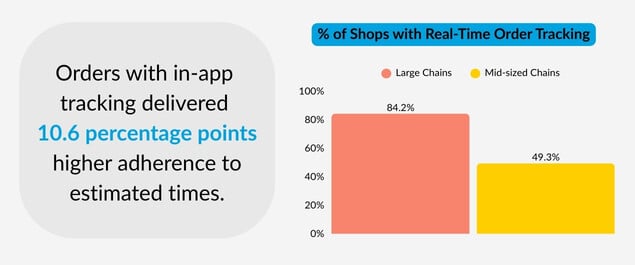
One factor shaping that expectation gap is visibility. As a new metric in this year’s study, we examined the impact of in-app order tracking. Brands offering live tracking saw 10.6 percentage points higher adherence to estimated delivery times, and large pizza chains were far more likely to provide real-time updates than mid-sized brands.
At the brand level, Papa John’s posted the fastest total delivery time, finishing two and a half minutes ahead of third-place Domino’s. And MOD Pizza ranked as the fastest carryout provider for the second consecutive year with a total time of 16m 4s.
While the study clearly shows that meeting estimated preparation or delivery times is associated with higher satisfaction, a more nuanced pattern appears when those estimates are not met.
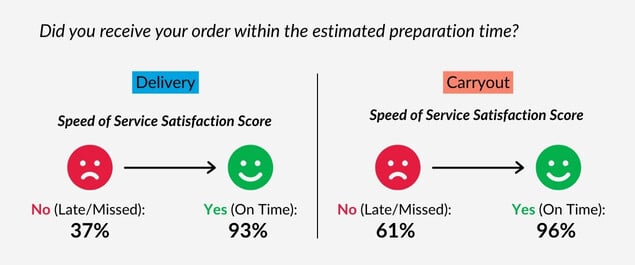
As shown below, carryout orders still recorded a 61% satisfaction score with speed of service even when the estimated preparation time was late/missed. But when delivery estimates were not met, satisfaction with speed dropped to 37%. That gap speaks less to timing itself and more to tolerance. Customers appear far less forgiving when delivery misses the mark, where the margin for error is significantly tighter.
So yes, speed still matters in the pizza industry. But in 2026, the pizza trends shaping satisfaction are less about how fast the order is in absolute terms and more about whether the brand lands where it said it would.
Mystery shopping programs capture an unbiased view of your customer experience.
See how organizations measure the ROI behind those insights.
In this year’s study, food quality emerged as the strongest driver of overall satisfaction, outweighing every other metric. Customers were more likely to accept slower service than a pizza that arrived cold or missed expectations on taste.
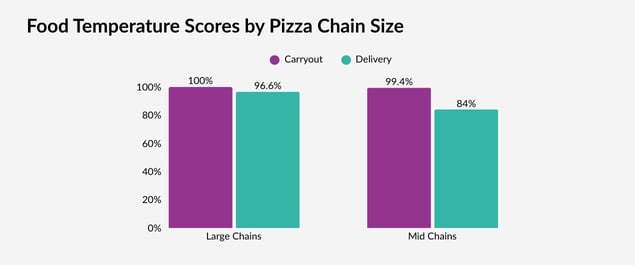
Temperature played a central role in that dynamic. OSAT was more than 53 percentage points higher when pizzas arrived warm. Carryout food temperature scores remained consistently high across both segments, while delivery performance among mid-sized chains averaged 84%, with the lowest-performing brand, MOD Pizza, at 69%. Download the full study to see which brands managed to deliver on both temperature and taste.
Flavor, however, proved to be fragile in delivery.
Across our study, delivery introduced a consistent gap between temperature and taste. Even when customers reported that their pizza arrived hot, taste ratings still declined compared to carryout. Carryout, by contrast, maintained strong performance across both measures, reinforcing its role as the benchmark experience.
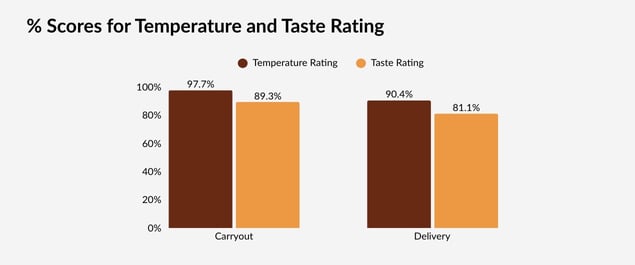
That gap points to a subtle but important dynamic. Delivery exposes pizza to factors beyond heat retention. Time in transit, handling, and packaging appear to influence how flavor is ultimately perceived once the box is opened.
Brand results reflected that variability. Some mid-sized pizzerias struggled to maintain food temperature in delivery, with ratings falling below 70%. Large chains like Little Caesars recorded a 100% temperature rating for its delivery, yet still posted a delivery taste rating of 71.4%. Similarly, many that preserved heat still saw taste scores soften as orders traveled farther from the store.

Pizza order accuracy today = smaller margin for error.
According to a customer perception survey of 1,447 North Americans, 30% ranked order accuracy as the most important factor when ordering pizza for delivery, just behind the 31% who prioritized food arriving hot.
On a brand level, Blaze Pizza posted the largest year-over-year improvement, lifting order accuracy to 95% from 86.7% in 2025. Marco’s Pizza stood out as the only brand to achieve a 100% order accuracy score in 2026.
Overall accuracy remained strong across the category, but how brands achieved it varied. To address persistent labor shortages and rising labor costs, many QSRs have turned to automated phone ordering systems as a way to stabilize execution. In this year’s study, automation was associated with higher accuracy rates, with fully automated calls reaching 95% accuracy and semi-automated calls reaching 97.8%.
Process changes rarely affect just one metric. With automated systems in place, accuracy did not move in isolation. When orders were handled through automated phone systems instead of by employees, overall satisfaction declined. OSAT trailed by 5.7 percentage points compared to orders taken entirely by staff.
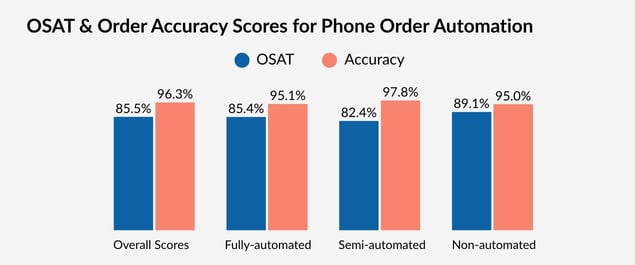
Donatos Pizza, which showed no automation in last year’s study, leaned heavily into the approach in 2026, with 55.2% of orders handled through fully-automated calls. Meanwhile, a few brands which had used some full-automated calls in 2025, leaned heavier towards full-employee based calls. The full pizza study breaks down how these approaches varied by brand.
Learn How to Interpret Mystery Shopping Scoring for Brand Improvements.
Employee interaction remains one of the quieter pizza trends shaping carryout success.
A pleasant and friendly carryout interaction ranked as the second-strongest correlate to overall satisfaction. Customers who described their pickup experience as pleasant reported 95.2% satisfaction, reinforcing how much weight small, human moments still carry in an otherwise transactional visit.
“The young lady who was working the counter was super personable and gave me her full attention.”
- Mystery Shopper
Mid-sized pizzerias thrived in carryout, increasing their order fulfillment friendliness rating by 5.4 percentage points year over year, reaching 87.8% in 2026. As a result, mid-sized brands outperformed large chains by 10.8 percentage points on friendliness in this category.
Leading the charge, Donatos Pizza had the highest in-store staff friendliness rating of 93.5%. Among large chains, the most notable year-over-year improvement came from Little Caesars, which increased its friendliness rating by 16.6 percentage points.
Attentiveness, however, showed more strain.
For mid-sized chains, the share of staff who appeared attentive (not on a personal device) fell from 85.0% to 77.6%. The drop for large chains was even more significant. Read the report for the details.
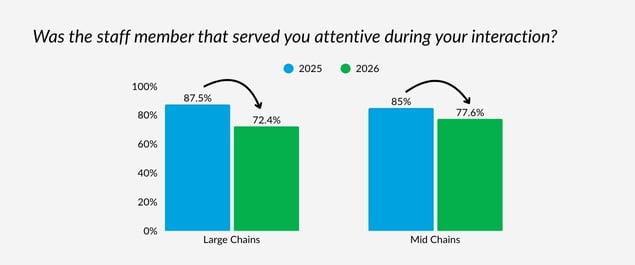
First impressions leave a lasting mark as well. Among carryout visits, 75% of customers were verbally greeted upon entering large chains. Mid-sized pizzerias differentiated themselves in another way, smiling at customers 63.5% of the time compared to 55.9% at large chains.
In this year’s study, roughly one quarter of delivery orders were fulfilled by third-party drivers, even though all orders were placed directly with the brand. That distinction matters, because once food leaves the store, control over timing, handling, and presentation begins to shift.
The data shows clear differences in how the experience plays out depending on who completes the delivery.
Food temperature scores were highest among brands where delivery was handled without any reliance on external providers, averaging 96%. Brands that incorporated outside delivery support more frequently averaged 82.6%. Satisfaction followed a similar pattern, with OSAT averaging 86.7% for brands with no third-party delivery fulfillment, 83% for those using it occasionally, and 76.7% where it appeared most often.
We also observed how total delivery time separated the groups, with over eight minutes between the fastest and slowest delivery mixes.
Among mid-sized pizza brands, where third-party delivery support appeared more frequently, insulation surfaced as another challenge. The study examined how the presence or absence of insulated delivery bags aligned with temperature outcomes once food left the store. The full report details how this factored into those results.
From our previous work with Marco's Pizza: The data we’ve gained through Intouch has opened up conversations and helped us achieve a five-star guest experience across our stores.
- Mike Fox, Director of Operations, Authentic Pizza of Florida Marco’s Pizza Area Representative.
Staying competitive in pizza today comes down to precision. Knowing exactly how your brand performs at each step helps close the gap between “out for delivery” and a satisfied customer.
Built on real mystery shopping data, this study delivers brand-level insights into the execution details shaping delivery and carryout performance right now.
Want the full picture behind today’s pizza trends?
Methodology: The Intouch Insight 2026 Pizza Delivery & Carryout Report is based on 600 mystery shops across 10 national pizza brands, split evenly between delivery and carryout, conducted between September and October 2025. Orders were placed directly with brands via phone or app.
 Sarah Beckett : January 30, 2026
Discover the pizza trends proving that friendliness is a key driver of customer satisfaction and loyalty in today’s competitive pizza landscape.
 Sarah Beckett : January 13, 2026
How does third-party delivery impact your pizza brand? Explore insights from the 2026 Pizza DELCO Study on customer experience and delivery...
 Sarah Beckett : April 25, 2025
Pizza trends reveal a new contender in carryout: Are C-stores outpacing traditional chains in speed, taste, and satisfaction?