Imagine this: Leaders of a national chain gathered for their quarterly business review after a period of rapid expansion. The conversation started with a familiar challenge: CSAT scores were showing some unexpected variance across regions, and new signups for the loyalty program weren't growing at the pace they had expected.
They looked through reviews, mystery shopping reports, and in-store observations. Patterns emerged. The best-performing locations weren’t just clean or fast. They made customers feel known, taken care of, and understood. Whether someone ordered online or walked in off the street, that connection made all the difference.
That meeting shifted how they approached customer experience (CX) across the board.
In 2025, that kind of reflection is becoming more common across multi-location businesses of all kinds; retail, restaurants, hospitality, and service-based operations alike. Customer experience is no longer viewed as a single department or just another KPI. Instead, it’s an end-to-end effort woven into every part of the business. With 73% of consumers citing CX as the most critical factor in their purchasing decisions, many brands are looking closely at what’s shaping the future, and what needs to change in their own operations.
Here are four customer experience insights guiding multi-location businesses this year:
- Hyper-Personalization: Tailoring Experiences for Every Customer
- CX Consistency Across Multiple Channels Builds Confidence
- AI is Changing Customer Expectations, But Human Touch Still Matters
- Employee Experience (EX) is the New CX Differentiator
1. Hyper-Personalization: Tailoring Experiences for Every Customer
Customers want to feel known. And in 2025, that means more than just a first-name email greeting. People expect brands to understand them on an individual level. Not segments. Not personas. Them. What they like. What they’ve ordered. What they need. But personalization must be helpful, not intrusive.
71% of consumers expect personalized experiences, and 76% notice when they don’t receive them. Businesses are responding by using data to shape individual journeys, whether that’s a product recommendation, a reminder based on past behavior, or a checkout experience that adjusts based on location or order history. For instance, a QSR app can recognize a frequent customer’s ordering habits and proactively suggest their favorite meal with a limited-time discount, making the experience feel truly “just-for-you.”
While QSRs can’t control what customers crave, they must ensure the process is seamless once that decision is made.
The Scope:
- Personalization boosts trust. QSRs can suggest a customer’s go-to meal the moment they open the app.
- Knowing a customer’s history increases CSAT scores. Hotels can streamline check-ins by pre-selecting room preferences for returning guests.
- Personalized loyalty programs support re-engagement. Retailers can tailor discounts, rebates, and perks to reward repeat customers, and 54% of CMOs are putting more budget toward loyalty for that reason.
- First-party data unlocks better targeting. Digitally native DTC brands already excel here, but with the right tools, any multi-location operator can close the gap.
- Predictive analytics is gaining momentum. With a projected growth of 28.3% by 2030, it’s helping brands anticipate needs and refine recommendations.
2. CX Consistency Across Multiple Channels Builds Confidence
A customer browses your app, calls with a question, then walks into a store, all in the same day. It happens more than you think. And 40% of consumers say having “multiple ways to reach you” is the most crucial aspect of a company’s customer service. In fact, those who engage across multiple channels spend more than those who interact with a business through one channel.
But being available isn’t enough. Every channel needs to feel connected as people don’t usually distinguish between digital and in-person interactions. If the promo on your app doesn’t match what’s in-store, that’s a bad look. If support tells them one thing and the cashier says another, that’s friction. And friction costs you business.
When brands get it right, the payoff is significant, with multichannel customers being 3.6 times more likely to purchase additional products.
The Scope:
- Seamless experiences build customer confidence. In retail, shoppers want to browse online, check local stock, and make a smooth in-store pickup without second-guessing availability.
- Consistency reduces support issues. QSRs that align app-based promotions with in-store menus prevent mismatched offers and customer complaints.
- Trust is reinforced when policies work across all channels. Hotels that let guests apply loyalty rewards earned online at check-in create a reliable guest experience.
- Integrated CX measurement strategies win. Businesses that bridge digital and physical CX can identify gaps, improve training, and make smarter decisions—especially as more industries like QSRs embrace digital customer experiences to meet rising expectations.
Meet your customers where they are, with CX software features designed to unify every step of their journey.
3. AI is Changing Customer Expectations, But Human Touch Still Matters
People are truly curious, even excited, about what AI can do. Around 70% expect it to transform the way they interact with companies, and that shift is already in motion.
In our latest Drive-Thru Study, the overall friendliness average across all brands was 79%. Early insights from the upcoming 2025 Emerging Experience Study show the tone of Voice AI also scored 79%—an interesting match to the drive-thru study benchmark. The overall friendliness average in the new study reached 83%, possibly reflecting how Voice AI helps free up staff to focus on more personal interactions.
Want the full scoop? Subscribe now to be the first to get the full Emerging Experience report when it drops.
AI-powered tools like chatbots, predictive analytics, and self-serve options are raising the bar for speed and convenience. But here’s the thing: While automation handles the heavy lifting, people still want to feel heard by humans. Especially when something goes wrong.
The Scope:
- Faster, more efficient service. AI-powered chatbots and self-service tools handle routine questions instantly.
- Predictive issue resolution. AI analyzes customer sentiment, past complaints, and operational data to fix problems before they escalate.
- Blended AI + human support is a win-win. Leading brands know when to step in with a real human touch. Many QSRs, for example, use Voice AI to take phone orders and switch to a team member for closing remarks.
- Greater impact on operations. CX leaders expect Generative AI to drive improvements in call containment and customer satisfaction.
Discover how blended AI + human support affects order accuracy in phone call orders, based on key pizza trends from our latest Pizza DELCO Study.
4. Employee Experience (EX) is the New CX Differentiator
Something shifts when a business starts viewing customer experience as more than just a score or a dashboard. For operators who live and breathe CX, the real turning point often comes when they look inward—at the people delivering those experiences day in and day out.
When employees feel equipped, valued, and confident in their roles, they naturally deliver better service. They greet guests with energy, offer help without hesitation, and make friendly remarks because they genuinely feel like it.
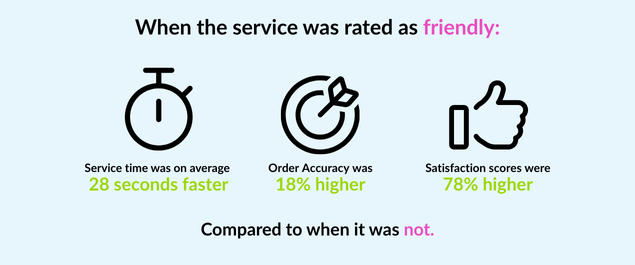
There’s data to support this approach as three out of four employees say they’re more motivated when they know their company genuinely prioritizes customer experience. And the results speak for themselves. In our Annual Drive-Thru Study, when the service was rated as friendly, the service time was on average 28 seconds faster, order accuracy was 18 percentage points higher, and satisfaction scores were 78% points higher, compared to when it was not.
Behind every great customer experience is an employee who felt empowered to make it happen. For operators who see that clearly, investing in EX is how loyalty gets built.
The Scope:
- Better problem resolution. Happy employees go the extra mile to help customers. In QSR, digital checklists reduce mental load in operations, improve restaurant efficiency and help staff focus more on customers.
- Access to customer data empowers frontline teams. 58% of agents say that a lack of consumer data often results in negative customer experiences. Retailers using digital dashboards see staff respond with more confident service.
- Positive cultures fuel better customer interactions. When employees feel heard and supported, it reflects in every guest experience.
Building a Strong CX Strategy
If your CX strategy isn’t evolving, neither is your brand. The good news? There are tools that can help you effectively measure insights and bridge gaps. If you're ready to level up your approach, here are four powerful ways we can help you bring it to life:
| CX Platform |
Want more loyal customers? Start with a CX platform that brings all your customer insights together. When you can spot patterns and act fast, creating personalized experiences becomes second nature. |
Request a demo of Intouch's SaaS CX Platform.
| Mystery Shopping Services |
Wondering what the experience really feels like? Mystery shopping gives you that unfiltered view. Real people walk through your process: online, in-store, on mobile, and highlight where things are working and where they’re not. |
Start evaluating your experiences with Mystery Shopping Services.
| Survey Tools |
Want to know if AI is helping customers complete tasks with ease, or creating friction along the way? Survey tools measure how well technology supports the experience, flag where automation falls short, measure if brand-specific CX goals are met by technology, and identify when human support makes the difference. |
Build your own customized surveys using IntouchSurvey®.
| Mobile Inspections |
Trying to support your team better? Mobile inspections simplify daily tasks with digital checklists and real-time tracking, so employees can spend less time on paperwork and more time creating great experiences. |
Simplify team operations with mobile inspections powered by IntouchCheck®.
The Time to Invest in CX is Now
Here’s the truth: 89% of companies will compete primarily on customer experience in 2025. That means if you’re not actively improving, you’re falling behind.
Businesses investing in CX today are shaping what success looks like tomorrow. Now’s the time to take a hard look at performance, share insights across teams, and ask: Where are we strong? And where can we raise the bar?
When you’re ready to take the next step, whether it’s measuring your performance, improving your consistency, or tightening up your operations: there’s a team that can help you do it right.
Let’s talk and build a CX strategy together!

 Sarah Beckett


 Sarah Beckett : June 25, 2026